OSB_5F_1045M / 2026-08-07
Why the bass reaches you
Outdoor stage → fifth-floor window · Frýdek-Místek · 7 August 2026
63 Hz remains. 4 kHz disappears.
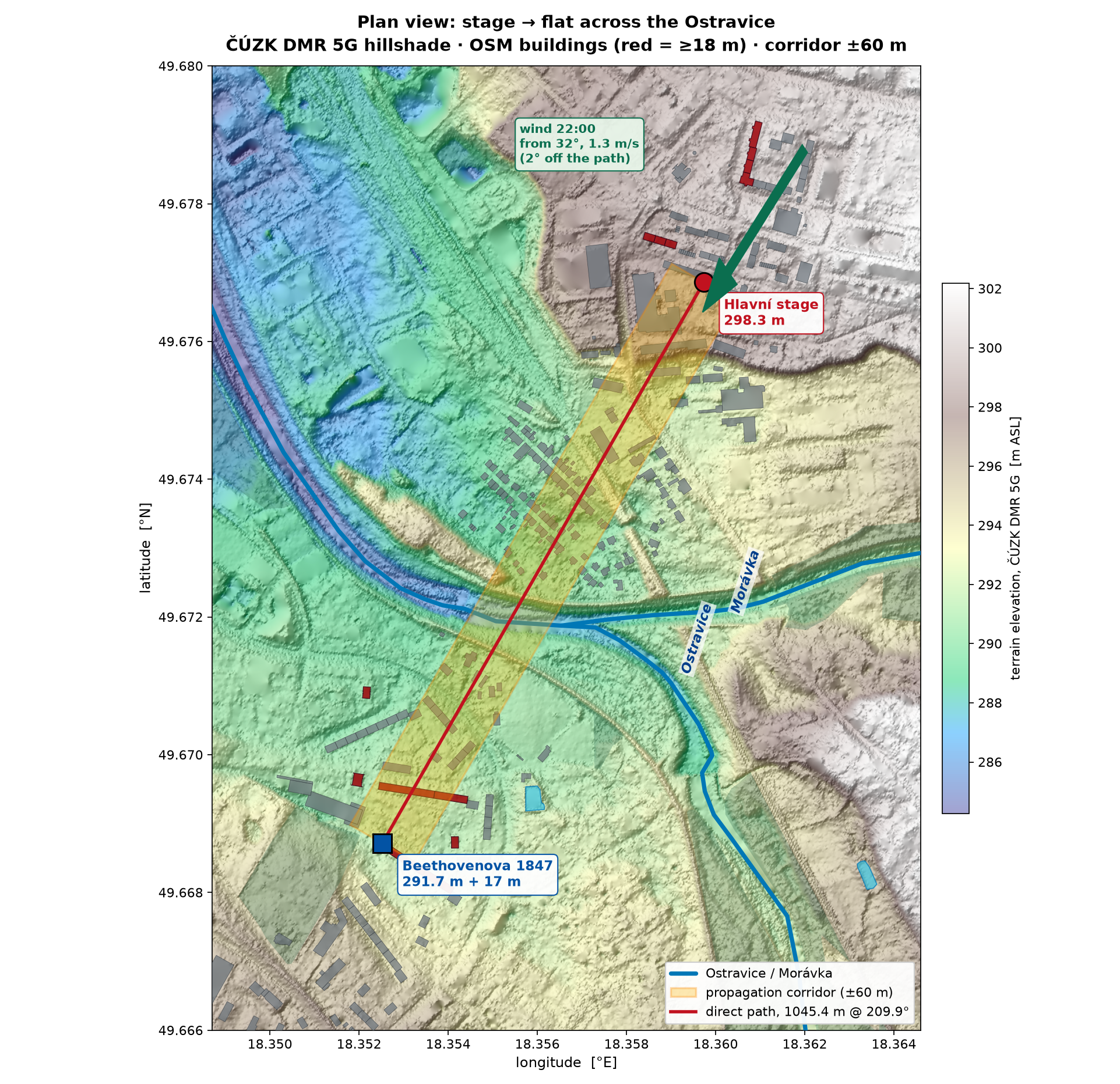 plan → section
exact route / 1045.4 m
298.28 m ASL
5th floor
 live trace continues
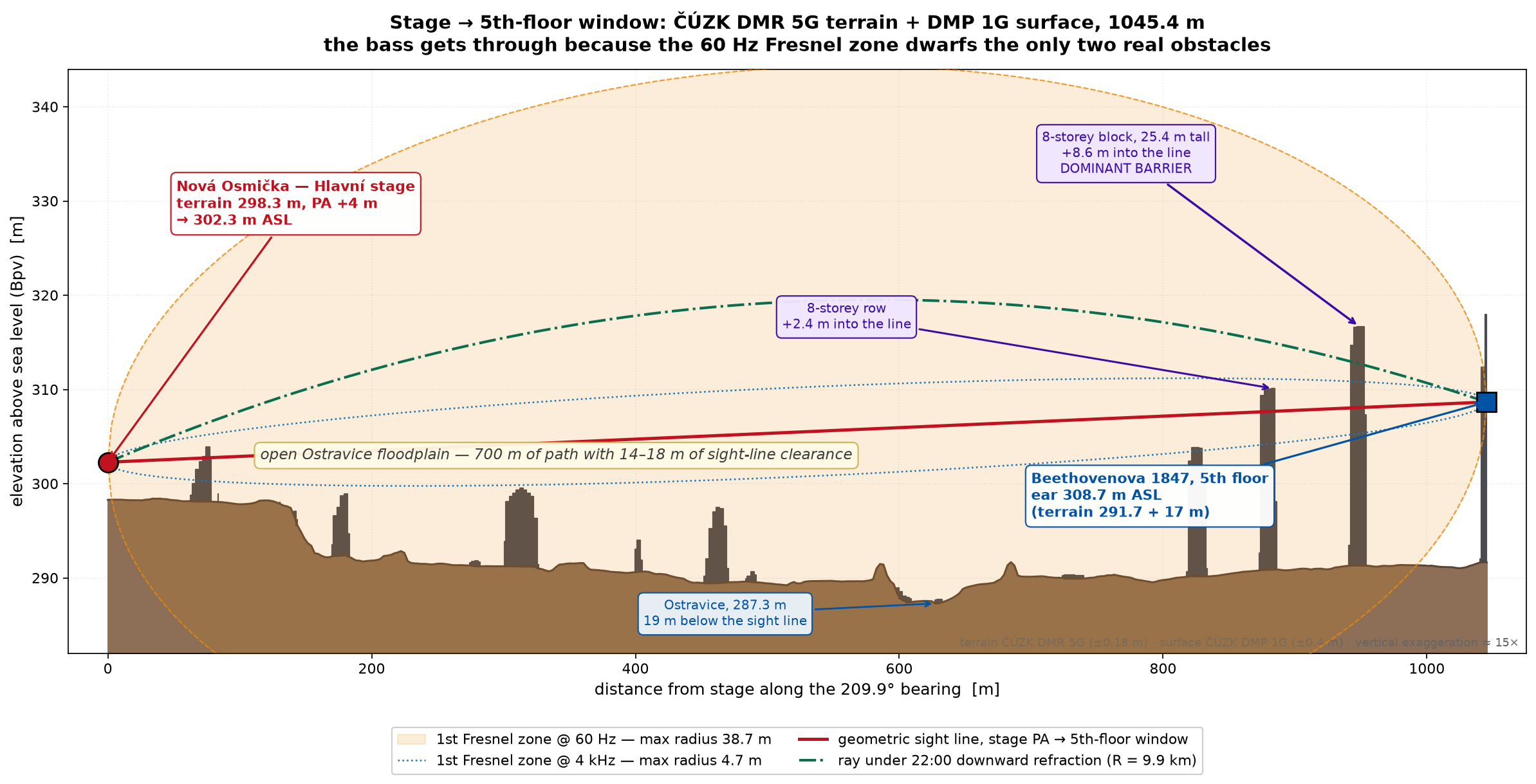
plan → section / terrain + barriers
The venue is 6.6 m higher, but that buys only 0.3 dB.
Your fifth floor buys 5.7 dB.
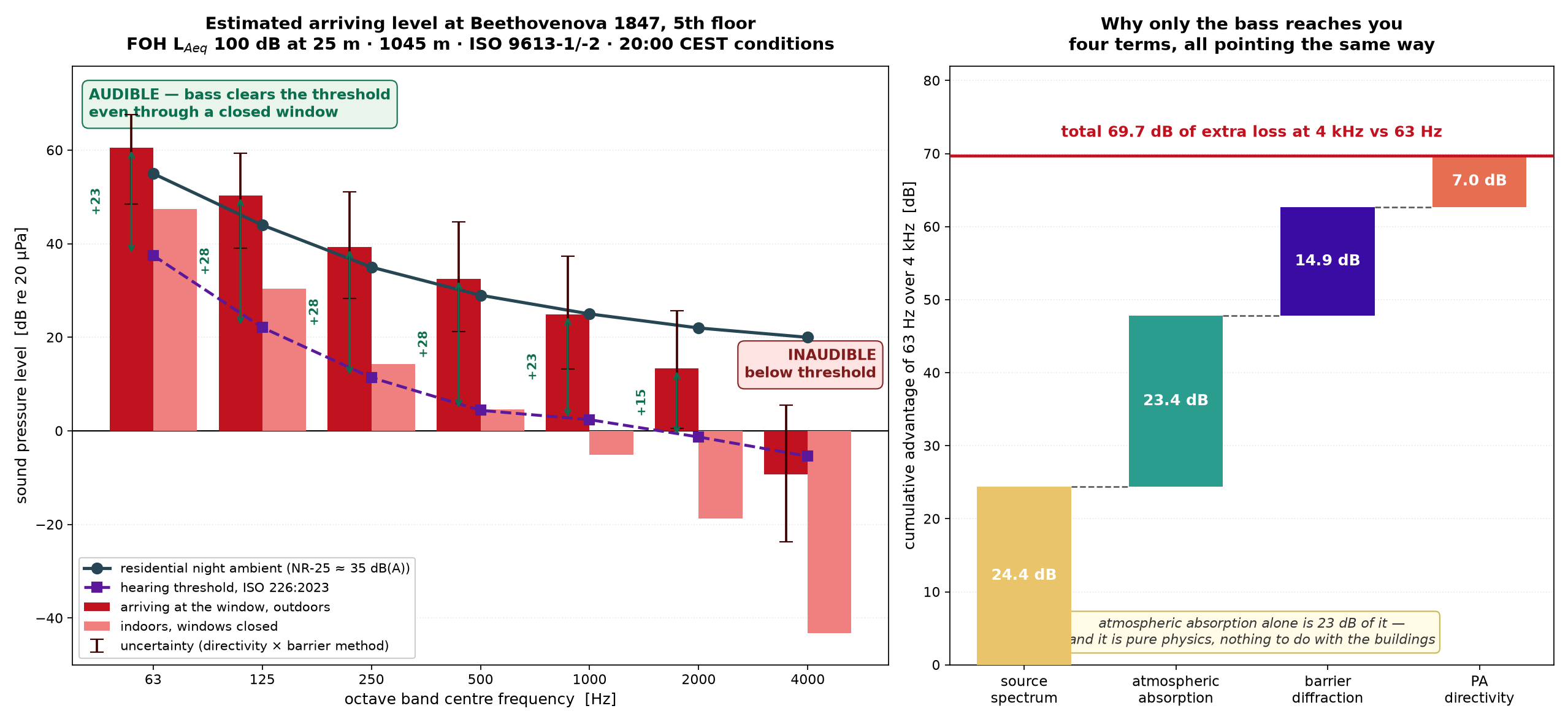
The frequency gap reaches 69.7 dB.
The path is almost open.
Bare terrain never blocks the route. The floodplain gives 700 m of clear propagation; only two apartment rows enter the sight line near the receiver.
Geometry ledger
- distance
- 1045.4 m
- bearing
- 209.89°
- stage terrain
- 298.28 m
- receiver terrain
- 291.68 m
- receiver ear
- 308.68 m
- dominant barrier
- 25.4 m
The dominant block is 91% of the way along the route. Receiver height therefore has roughly ten times the leverage of elevation at the source.
Four filters remove everything except the low end.
The source already favors bass. Air then removes another 23.4 dB at 4 kHz relative to 63 Hz. Buildings add 14.9 dB of frequency discrimination, and PA direction adds the final 7 dB.
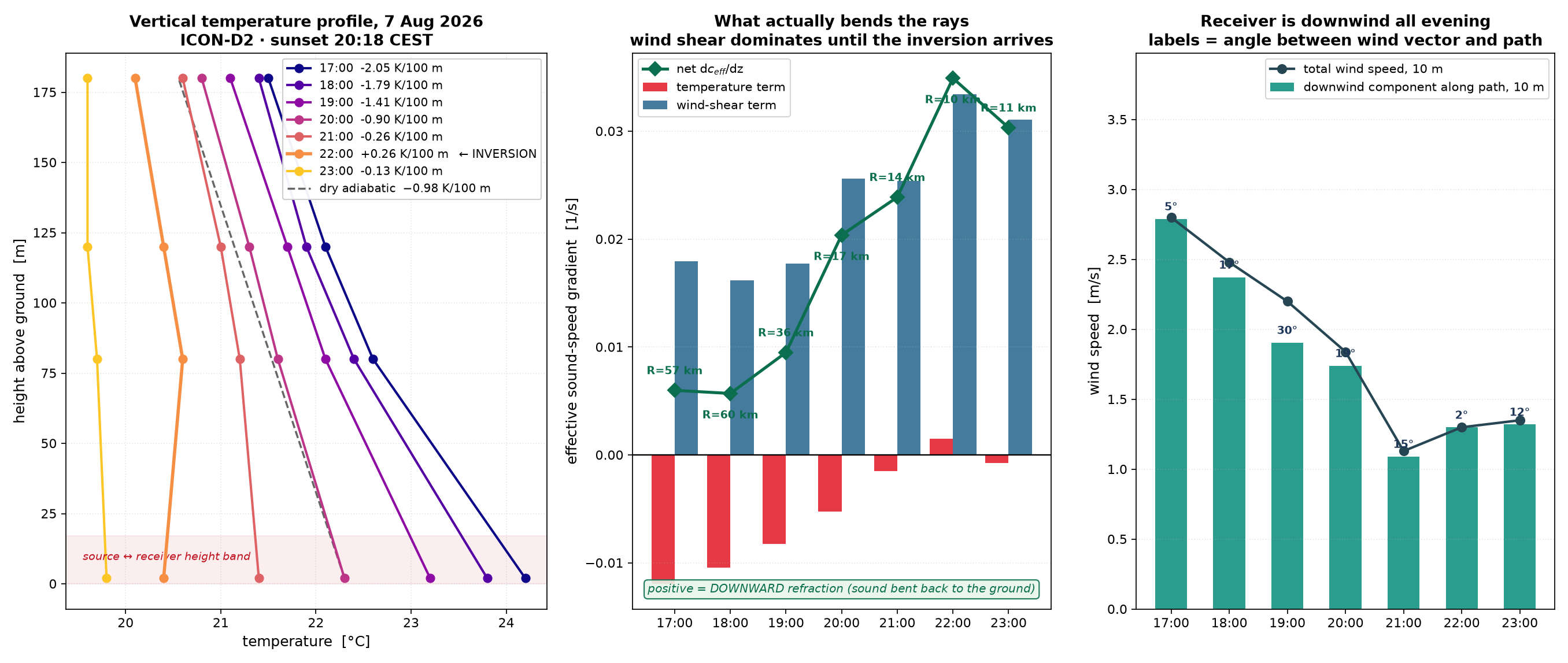
The wind points almost exactly down the route.
At 22:00 it came from 32°. The back-azimuth to the stage is 29.9°: a two-degree miss. Wind shear bends sound downward all evening; a true temperature inversion appears only at 22:00.
- wind
- 1.3 m/s
- path offset
- 2°
- ray radius
- 9.9 km
- modeled gain
- +2–5 dB
Inspect every metre of the route.
Zoom, pan, and click the interactive trace. The map carries the per-sample terrain and surface clearance used in the analysis.
Measured geometry. Modeled sound.
The route itself is unusually well constrained. The largest uncertainty is not the terrain or buildings—it is the unknown directionality of the concert PA.
Replace “the venue is higher” with:
I am high enough to see over the last row of blocks, and bass barely notices what is left.